
WAT Mobilite - Case study
How Runibex rebuilt WAT Mobilite's EV charging platform as a multi-tenant product
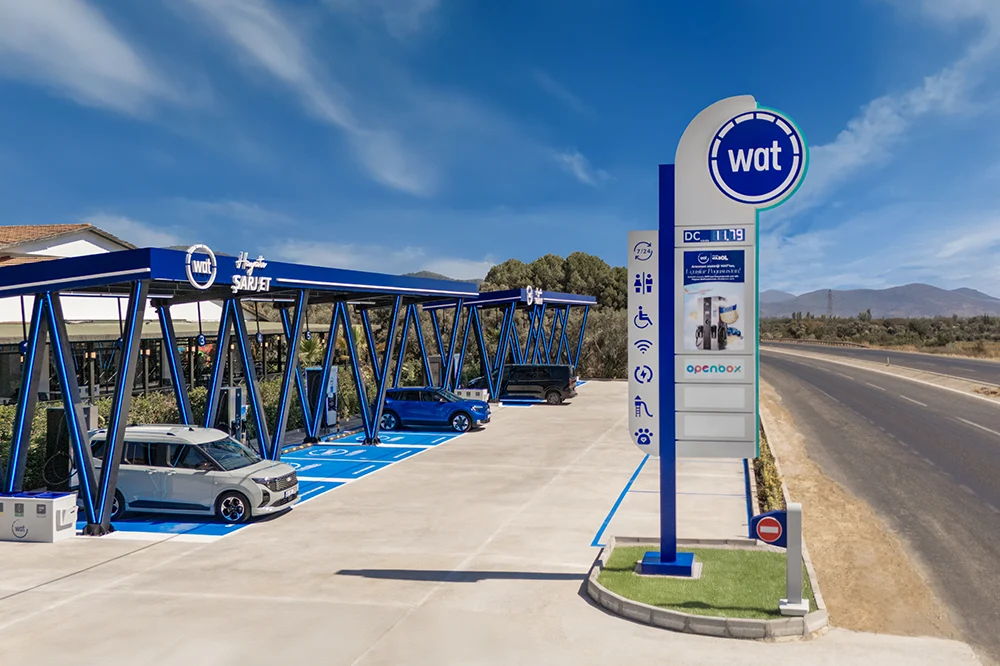
WAT Mobilite’s network covers 700+ charging stations and 2,000+ sockets across Türkiye. Runibex rebuilt the platform on a modular, microservices architecture so new hardware and regulatory changes can be absorbed while it stays running.
At a glance
Platform availability
99.89% uptime
Release speed
Delivery cadence
Zero-downtime releases every two weeks
Enabled New Horizons
New horizons
Platform now offered to the wider market, with new data and AI capabilities

Background
WAT Mobilite is one of the companies leading the build-out of electric vehicle charging infrastructure in Türkiye. Its network lets drivers locate, access, and pay for charging across the country, and it works: Vehicles are charging on it every day at more than 2000 points.
That working platform, however, was not built for the world it now operates in. It was commissioned as a conventional software project: a fixed scope, a delivery date, and an assumption that the system would simply run from there.
EV charging does not behave that way. Regulation shifts, charger hardware and vehicles keep changing, and energy providers, suppliers, and regulators introduce new requirements continuously.
Run a living system on project-era assumptions and it turns brittle. By the time WAT approached Runibex, the inherited platform had reached exactly that point: Increasingly hard-to-manage, and more expensive and difficult to change with every release.
Why stability was not a “nice to have”
EV charging infrastructure is more critical than most digital services, and the failure mode is unforgiving. When a driver pulls in with the battery at three percent and the station will not deliver a charge, that is not an error message on a screen. It is mobility coming to a stop.
Each of those moments cascades: A stranded driver becomes a support crisis, a reputational hit, and an incident that escalates all the way to WAT’s senior leadership. In a business like this, reliability is not a secondary metric to optimise later. It is the foundation of customer trust, and it was the foundation that was eroding.
Why this was a product development problem
Runibex’s opening assessment was blunt, and it reframed the entire engagement: This could not be solved as a software project, because it was not a software problem. It was a product development problem.
A rebuild would have produced a newer system with the same fault line, a fixed artefact in a world that refuses to hold still. The question was not how to ship a better version. It was how WAT could move from project-based delivery, where every change is a fresh negotiation of scope and cost, to a sustainable product operating model, where the platform is expected to evolve continuously and is built and organised to do so.

Runibex’s approach
Runibex addressed the problem on three fronts at once: the product mindset, the architecture, and the way the two organisations work together.
01
Product management and a living roadmap
Runibex assigned product managers whose forward-looking vision became a living roadmap, and established a roadmap culture inside the engagement: clear ownership, planning that looks ahead rather than reacting, and prioritisation driven by return on investment. Every proposed piece of work is now tested against a single question: what will this add?
02
A modular, microservices architecture
Runibex designed a modular, microservices-based architecture built to evolve without disruption. New charging hardware, policy and regulatory changes, and additional integrations can be absorbed as modular upgrades while the platform stays running. Architecture here is treated as an enabler of change, not a fixed structure that resists it.
03
A co-development partnership
The collaboration was deliberately structured as a partnership rather than a classic client-supplier arrangement. Instead of handing down a finished specification, the two teams sit down together to define and solve problems, with scope that is shaped jointly as understanding grows. That fit WAT’s situation precisely, because WAT is shaping a genuinely new business model where the work is exploration, not the execution of predetermined answers.
The dedicated product team
The team Runibex stood up for WAT does not work like a conventional software team rented out across accounts.
It works vertically.
The team is dedicated to WAT and is not rotated onto a different project from one week to the next.
It is whole.
Product management, development, testing, and operational awareness sit together in one focused unit rather than being handed between separate groups.
It owns the outcome
Because the same people carry the product end to end, they can discover real needs early, avoid over-engineering, and build modular, reusable solutions instead of one-off fixes.
This is the practical difference between buying engineering hours and gaining a product capability.
Product development as a service
The deepest value Runibex brings to WAT is not engineering capacity. It is product development experience, delivered as a service. Runibex has spent more than a decade designing, building, and operating its own complex products. It applies that hard-won discipline directly inside a customer’s environment, which is what makes sustainable product development possible in a setting as uncertain and fast-moving as EV charging.
Runibex is not three engineers who decided to build something. It is a technology company that knows how to build products, and that knowledge, transferred into WAT’s teams and ways of working, is the part that does not show up on an invoice but changes everything downstream.
Outcome
Working with Runibex, WAT moved from a static, inherited platform to a resilient, product-led digital ecosystem. The change is visible across five dimensions.
Stability regained.
The rebuilt platform now runs at 99.89% uptime, with zero stranded drivers in the field.
Greater agility
Releases and regulatory adaptations now ship every two weeks, while avoiding sleepless nights.
Assured continuity
Mission-critical charging stayed available under peak demand, sustaining countless transactions over 2K stations, while being integrated with financial and regulatory systems in real time.
Scalable growth
The modular design lets new technologies and new market entries be integrated without re-architecting the platform each time.
Business shift
WAT now offers technology solutions to the market, builds new data and AI capabilities on the platform, and supports roaming with partner networks. A set of business opportunities that did not exist before.
The single most important outcome is harder to put in a single number, and more durable than any of them: WAT did not just receive a working platform. It gained a product development capability of its own.
From internal platform to sellable product
The ambition does not stop at a system that runs reliably. The vision is to turn WAT’s charging platform into a product in its own right, one that can be offered to others rather than serving WAT alone. Technically, that means a multi-tenant platform: a single system on which different brands operate with their own identity, branding, and operational rules.
Runibex’s role extends into that commercialisation. Beyond building the platform, Runibex will help take it to market, positioned as a product created through the Runibex and WAT Mobilite partnership. The result is a company that no longer only sells energy, but earns from its software platform as well, with Runibex as the strategic partner supporting the joint evolution of both the product and the organisation behind it.
Why Runibex
WAT chose Runibex for a record that sits where engineering excellence meets product strategy. With more than a decade designing, building, and operating enterprise-scale digital products, Runibex helps organisations move from projects that deliver once to platforms that keep evolving.
For WAT, the partnership produced two things that compound over time: A stable, scalable technical foundation, and a product development culture capable of sustaining innovation in one of the fastest-changing industries in the world.